

I first heard Fireboy DML’s music in 2019 during one of my evening walks. I was a depressed graduate going through a romantic heartbreak as well as receiving rejection emails from companies I had applied to for work. Those evening walks were the only therapy I could afford. Those, and music.
I was listening to songs on Spotify when ‘Jealous’ shuffled in. If there was a musical version of love at first sight, that was what happened to me. ‘Just one taste and I’m wanting more’ was such a banging opener. When I got home that evening, I sat through the rest of Laughter, Tears & Goosebumps, his debut album. What I heard was a brilliant songwriter and a master of melody. It wasn’t surprising to learn that he was also a poet. You could hear the careful writing in his lyrics. There were many standout tracks on that album, and not one was lacking in songwriting. That album saved me from my great depression of 2019.
Given that impressive debut, I expected greater things from Fireboy. I believe 2020 was a remarkable year for Afrobeats, mostly because of the rise of the generation known as Wande Coal’s sons. Fireboy bore his influence the most — there was that special feature on his Apollo album, where he and Wande Coal exuded insane chemistry on ‘Spell’ — but there were also Oxlade, Omah Lay, WurlD, and Joeboy. What these guys had in common was a gift for songwriting. For all its glory, lyricism had never been one of Afrobeats’ strongest chops. Afrobeats was mostly about rhythm and melody. Of course, old heads like 2Face, Darey Art Alade, and 9ice were brilliant songwriters, but they were relatively few. Those were years when people who prided themselves on being lovers of good music still boasted about not listening to Afrobeats, and their main criticism was the poor songwriting. Wande Coal’s sons seemed poised to change that discussion.
I remember having a chat with a big bro in the industry who predicted that these boys would take Afrobeats to the next level. Fireboy, he said, was their leader. A few years down the line, it is sad to say that his prediction hasn’t quite come true. Yes, we had ‘Afrobeats to the World’ — a couple of years when Afrobeats took over the global music landscape. This was both a blessing and a curse for Afrobeats. It made our artists focus more on streams and numbers, and the craft suffered for it.
There was the year when everyone was about Amapiano, the South African import. It gave us Asake and his infusion of rich Yoruba lyricism, but the rest of the industry sounded monotonous and boring. Afrobeats plateaued around 2024, especially in the quality of its songs and its ability to produce new breakthrough stars with new and unique sounds. If there is anything that epitomises the present wave of Afrobeats mediocrity, it is Fireboy DML’s new album, ZUKO!.
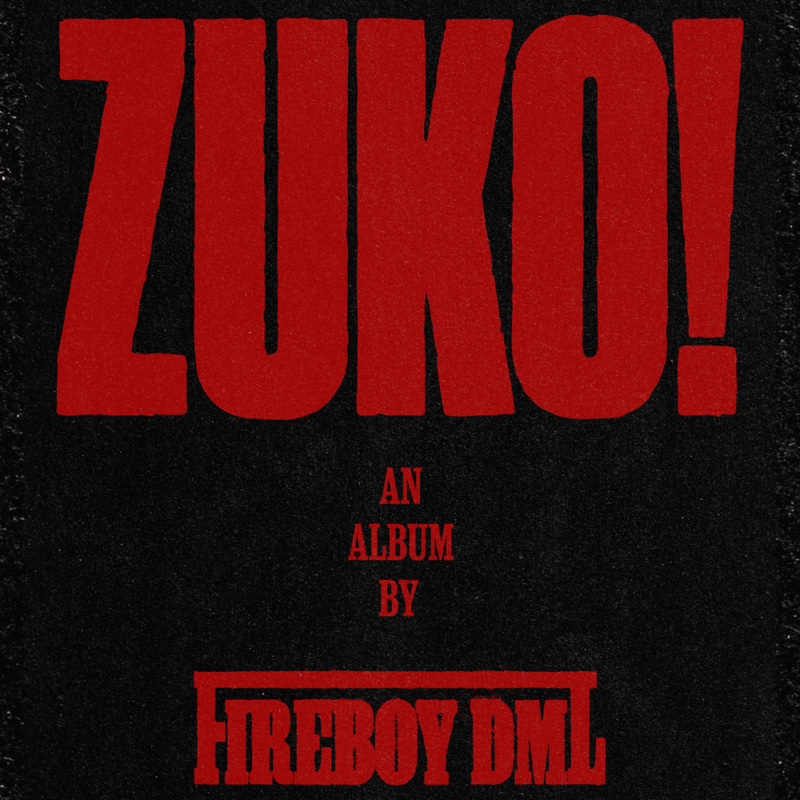
ZUKO! is a thirteen-track album. Its title, Fireboy says in an interview, is inspired by the persona he adopted while making the album — a more vocal, more expressive version of himself.
The opening tracks hold some promise. The album begins with ‘Dear Father’, in which Fireboy takes us to church. Produced by David Forlu, it is a solemn, prayerful song with a soft touch of piano and strings, in which he pleads against falling. There is little people at the top fear more than the journey back down, and this track is heavy with that anxiety. The next track, ‘By Fire!’, follows the same churchy mood, but the prayer has changed. If ‘Dear Father’ is a solemn plea, ‘By Fire!’ is Pentecostal in its aggressive tone. Over Reward Beatz’s production, Fireboy borrows the spiritual warfare language of MFM and the Celestial Church. The Christian imagery is rich: ‘I’m the Samson before Delilah, I’m the David, send down Goliath… I’m Elijah, send down the fire.’ This is a more confrontational Fireboy than the soft-spoken, romantic Casanova we used to know. Both ‘Dear Father’ and ‘by Fire’ rely on repetition, a familiar element of Nigerian Christian music, which suits the solemn pleading of one and the fiery declarations of the other.
‘CLAAT!’ departs from the spiritual mood of the first two tracks. A bouncy Afro-dancehall song produced by Ramii, it finds Fireboy testing the waters of a different sound. Jamaican dancehall star Masicka is more at home here, and his presence gives the track its bite.

Fireboy teams up with Lojay on ‘Goddess’, one of the more promising tracks on the album. Produced by Black Culture and Arieenati, it is a lustful anthem on which Fireboy finds his rhythm. Lojay, with that peachy voice, proves a competent compinche.
The NXRTH-produced ‘C’est La Vie’ is a groovy heartbreak song with lively horns and a highlife and soukous feel. Even though this one will rock the club, there is something quite sad about Fireboy still releasing this kind of song seven years after his debut. The melody and rhythm sound simplistic and show little artistic growth. It sounds more like the work of an artist chasing their first hit. Think of Rema’s ‘Dumebi’, an enjoyable debut single but one would set the benchmark higher for him seven years into his career. From Fireboy, I expect more melodic finesse.
On ‘Imali’, Fireboy enlists JAZZWRLD and Thukuthela for a turn towards the South African 3-step sound — a blend of Amapiano, Afro-tech, and Afro-house. ‘Imali’ means money in isiZulu, and that is his concern here. JAZZWRLD handles the production, but the featured Thukuthela does not bring enough vim to the song. It could just as well have been a solo track without losing much. Still, it is one of the album’s decent offerings.
‘One Man Regiment’, produced by Ramii and Dot Da Genius, returns to a dancehall-leaning sound. It is bubbly and lively, with Fireboy boasting of his resilience like a buffalo soldier. ‘One Man Regiment’ is quite an earworm, a decent experiment with new sounds.
By this point, however, the album’s promise begins to wear thin. The decline becomes more noticeable from ‘Kilowi’, where the songwriting shows signs of little effort, and even the beat by Big Fish cannot save it. It is another heartbreak song on which Fireboy offers nothing fresh. The mood is not sad enough to make you feel something, and the sparse writing leaves it emotionally dry. Again, Fireboy sings about resorting to marijuana, a constant feature in his lyrics these days. It is one of those songs you forget as soon as it ends.
On ‘Onazo!’, produced by Yung Willis, Fireboy stresses that he is in a vacation mood and has no time to be stressed. There are moments afterwards that briefly recover some interest, like ‘Sex Love Understanding Trust’, another Ramii production, on which he mostly pines for his lady’s body. Its catchy chorus makes up for its poor verses.
‘Light of Dawn’, produced by Aifo and NXRTH, has problems with both its writing and production. This is supposed to be a profession of love, but he has his doubts as he is not sure if he feels this way because he is wasted or in love. He moans his way through the chorus, but the instrumentation overpowers his voice. It is like kissing with your nose mask on.
‘Mimi Nawe’, with its country music influence, offers something stronger. The title means ‘me and you’ in Swahili, and Fireboy is vulnerable here, longing for companionship on the lonely road of life. To me, it is the standout song on the album, with a solemn mood that stirs some feeling in you. He probably should have closed the album on that strong note. Instead, he closes with ‘Fighting’. Here again, Fireboy fills the verses with his indulgences: smoking and drinking. As the title suggests, he is fighting for his life, donning a fake smile to grace the stage. The chanty chorus is the high point of the song.
There are decent moments in this latter stretch of the album, but too many of the songs dull the album’s early promise. ‘Kilowi’, ‘Onazo!’, ‘Light of Dawn’, and ‘Fighting’ feel underworked, as though they were rushed and assembled to make up the numbers for the album.
My major problem with ZUKO! is how little musical growth Fireboy shows. I give him credit for his experiments with new sounds, but there is not much artistic maturity aside from that.
Fireboy is hardly alone in this. Women and money remain the most prevalent themes in Afrobeats, and there is little incentive for artists to explore much else. It is a sign of the times, a reflection of the soul of a nation whose youths are preoccupied with hedonism — which I myself am a fan of — and money. It is what pays. For all its moments of prayer and vulnerability, ZUKO! keeps returning to that same limited thematic range.
I think that after their initial success, too many Afrobeats artists seem more concerned with numbers and streams than with developing their craft. Despite new singles being released every Friday, too few of these songs have the staying power of, say, the songs from Asake’s debut run. The new releases are forgettable the moment they stop playing. It makes me wonder how many of this generation will have the staying power that 2Baba has had.
ZUKO! is not a bad album, but it is not an excellent one either. It is comfortably lukewarm, which I think is worse because it may hide the need for improvement.
Adeola Juwon is the author of Ellipsis and Songs for Ori. His poems and reviews have been published on AfricanWriter, Afrocritik, Icefloe Press, The Newcastle Review and elsewhere. He is poetry editor at Lion & Lilac. He lives in Oxford, England.