King Sunny Ade — City People Magazine
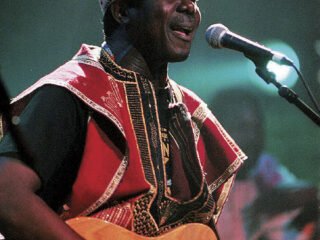
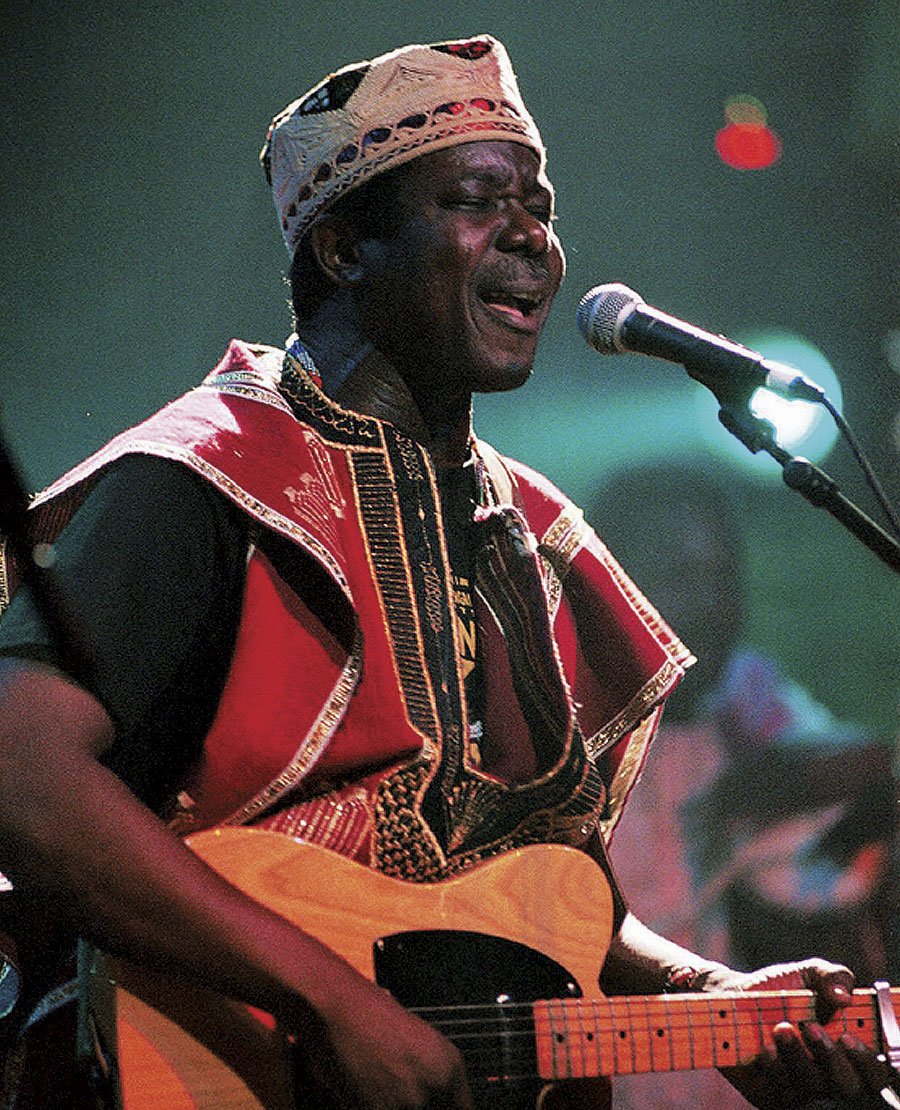
A small but telling detail of King Sunny Ade’s life often gets overlooked, and he touches on it briefly in the opening pages of his autobiography, My Life, My Music (2006): his father was an organist. He played the pipe organ when the main organist was away. In the full context of Sunny’s life over the last eighty years, it is instructive that it was the pipe organ — the most architecturally Christian of musical instruments and the most quintessential piece of Anglicanism — that was the first musical authority in the life of someone who would go on to be known as The King of World Beats, and whose music would play between two worlds: his Christian faith and the Yoruba pantheon that became a permanent fixture of his artistry.
KSA, perhaps more than anyone in Nigerian music history, exemplifies the famed syncretism of the Yoruba people, which in turn largely defines their music. He released his first album, Alanu l’Oluwa, in 1967; twenty years later, he flipped that sentence into English to create The Merciful God; and many years later, he publicly became “born again” at Redemption Camp, the vast grounds of the Redeemed Christian Church of God. But he’s also the one who beseeched Korikoto, the Yoruba goddess of fertility and children, to protect his kids, and the one whose Grammy-nominated album Odù is named after the sacred Ifa repository.
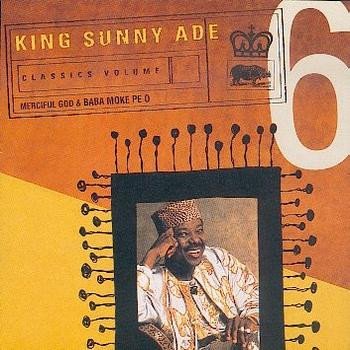
Yet, there is no contradiction in his beliefs. As a matter of fact, there is no separation either. His connection to the supernatural preceded his birth. He was the last child of his 50-year-old mother, who had had eleven children and lost eight, and was the fulfillment of a prophecy that predicted her birth of a special child whose fame would be known globally. That prophecy came true: by the time he turned 22, he had become a major music star in Nigeria.
At 80 years old today, Sunny Ade’s layered spiritual imagination is fascinating because it has yielded no less than six decades of public life, more than a hundred albums, ten thousand live performances, and one of the most complex bodies of thought in African music.
Juju itself was born at a crossing of worlds. Its earliest melodies were adapted from Yoruba folk songs, following in the tradition of its ashiko, agidigbo, and palm-wine progenitors. But it wasn’t until the tambourine entered the mix through Salvation Army members on Lagos Island that itinerant performers took an instant liking to the instrument for its versatility: it had rattles and a leather face, and it could drive an audience into a frenzy. In time, the name “Juju” came from the players’ penchant for tossing it in the air, using the Yoruba word “to throw.” From those 1920s/30s beginnings, Juju evolved several times before Sunny Ade arrived on the scene.
An inaccurate word association plagued the genre for many years: many musicians explained that Juju was not the same as juju, a colonial pejorative used to describe indigenous traditional beliefs of the Yoruba and other peoples of West Africa. In any case, no African language has “juju” in its vocabulary, and most certainly not Yoruba. It is an exonym from French sailors and explorers in the 18th century who described the articles and objects of worship as joujou — toys.
But even a cursory listening to Sunny’s discography will reveal an affinity for the sacred and the spiritual, if not fervent devotion. He is the most potent link between Juju the music and juju the practice. Even as a child, he’d been torn between the Catholic church school and the African church school he attended because while he admired the order of the priests and nuns and their hymns, he could not resist the familiar music and dance of the African church denomination. That dichotomy has stayed throughout his life.
Asked directly by Afropop Worldwide whether he could include Yoruba traditional religion as well as Christianity in his music and philosophy, KSA’s answer was both immediate and precise: “Yes, I do. The reason I don’t clash them, I don’t compare them to each other. I believe that God is the highest; he made all these things possible for man. It is for you to go where you want to go, as long as you respect the highest.”
This is neither a vague ecumenism nor the spiritual laziness of a man who cannot be bothered to choose. It is, rather, a very specific Yoruba metaphysical position, rooted in how the Yoruba have historically understood their own cosmology. Olorun—the sky god, the supreme being—sits at the apex of a hierarchy in which the Orisha are not rivals to God but emanations of it: intermediaries, divine functionaries. The Catholic who prays to a saint is not worshipping a rival god; similarly, the Yoruba who honours his familial deity is not denying Olorun.
KSA understands this structurally, and it frees him to move between registers that others might find contradictory. This is why his corpus can contain, without any sense of disconnect, gospel-adjacent songs of petition and thanksgiving alongside direct incantations. On his 1989 album The Good Shepherd, for example, he structures the theme around the Christian God, recognizing Him as his protector, even invoking the archangels Michael, Gabriel, Raphael, and the lesser-known Uriel. Yet in the very same breath, he relays his confidence in that God through an Ifa verse. And that is a recurring factor in his composition and life.
Perhaps the most direct engagement in King Sunny Ade’s catalogue is his treatment of Ogun, the Yoruba god of iron and a patron deity of the Ondo people. On the sleeve of his 1972 record, Ogun, Sunny Ade is photographed wearing an outfit of Ogun devotees. He explained to Afropop that it was a form of cultural preservation. “I love to hold on to the culture, so I sang about Ogun. On the day of the launching of the record, I showed people how to worship Ogun.”
As he himself sang, Ogun is present in everyday life, even if you do not profess to worship it. Whatever object contains iron is a vessel of Ogun, he says. “A secretary who claims not to worship Ogun, look at the tip of his pen; that’s Ogun. A housewife says she doesn’t idolize Ogun, but what about the necklace she’s wearing, Ogun ni!”
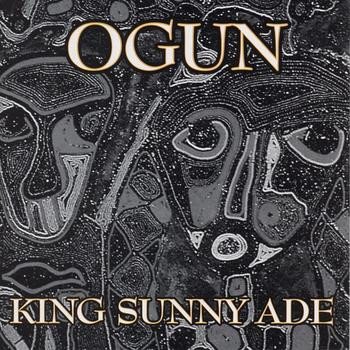
Some might read this as cynicism, but a more accurate reading is that Sunny, as an Ondo native and guitarist, acknowledges Ogun as the deity of his craft: symbolically, the god of metal instruments and iron tools, including the steel strings of the guitar. In this sense, his tribute to Ogun is not an ornamental gesture toward a tradition or heritage; it is an acknowledgement of the spiritual force embedded in the very tools through which he makes music. Ogun does not stand outside Sunny Ade’s modernity. He is present within its machinery, labour, technology, and sound.
This is where Sunny’s treatment of Ogun becomes especially significant. He does not present tradition as something sealed off from modern life, nor does he treat modernity as a departure from Yoruba thought. The guitar, the microphone, the recording studio, and the stage become new sites through which an older cosmology can continue to speak. Ogun survives not by resisting technology but by inhabiting it. In KSA’s hands, the deity of iron becomes inseparable from the machinery of musical modernity, and his Juju becomes the sound of that encounter.
In the Femi Adebayo Netflix film series Seven Doors, his character, the protagonist, faces a mystical monster that must be defeated for the story to reach a resolution. All through the film, its producer had told more than shown the importance of intra-tribal coexistence and an appreciation for other cultures over one’s own through the Yoruba-Igbo marriage of its lead actors. As the film reached its crescendo, Oba Adedunjoye took on Esusu, buoyed by the support of his babalawos and priests – who were also joined by Igbo dibias and medicine men, all of them raising a cacophony of prayers for the embattled king. It was a platitudinous scene that served no other purpose than to portray a cultural unity that ends up contrived.
Things like that don’t happen, and when they’re written into film scripts, we wave it off as the filmmaker’s creative license. Except that in the case of King Sunny Ade, a similar turn of events did happen.
As was foretold to his mother when he was a child, when KSA turned 45, he was struck by an illness that all but killed him. The prophecy had said he would experience a series of strange incidents every five years, culminating in the ninth cycle when he reached that age. That illness took him out of circulation, and nothing seemed to work – not specialist doctors, not herbs, nothing. It wasn’t long before rumours spread that he had died. A less charitable report suggested that the late Jimoh Aliu, theatre practitioner famously known as Aworo, had placed a spell on Sunny for having an affair with his wife, Orishabunmi. Baseless as it was, KSA had no time to dispel the rumour as he was fighting for his life.
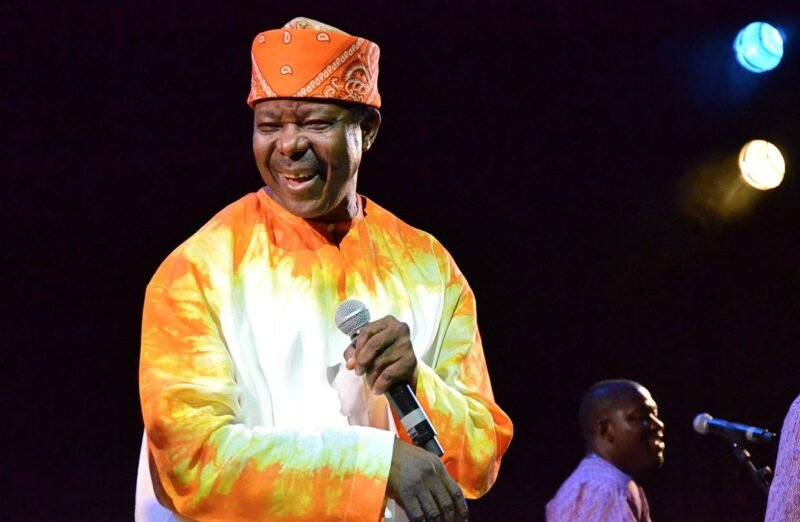
What makes the illness narrative spiritually remarkable is the extraordinary diversity of intercessors who crowd into it. “Christians, Muslims, traditional people, the Obas,” he writes in the autobiography— all converged around his sickbed. Oils and soaps, water and scripture, and all sorts of potions, as Nigerian society scrambled to get him back on his feet. To this day, he credits his recovery to the combination of the medical and the spiritual. His list of benefactors is a taxonomy of the spiritual world as King Sunny Ade inhabits it — Yoruba royalty and its theology, Christian prophets, Muslim clerics, traditional healers and government leaders — all acknowledged as having contributed to the same outcome. He sings about it in his comeback album of 1992, Triumph, on the track “Enia Laso Mi.”
While he’s not unique in his spiritual leanings in Juju music (IK Dairo was known as Baba Aladura for his Cherubim & Seraphim order, and Ebenezer Obey was ordained as a minister), he makes no bones about his syncretic approach to religion and spirituality. My Life, My Music captures his spiritual life by revealing how he worships. For one, he says none of his wives live, sleep, or even enter his private quarters. It is similar to the domestic arrangements of many traditional worshipers who, like the Levites of old and the Celestial Church of Christ today, believe that women have periods where they are unclean and could contaminate one’s holiness. Secondly, King Sunny Ade has a temple in his house, and no, he doesn’t like women going there.
This is significant on several levels. The man maintains a private sacred space, something that aligns more closely with the traditional Yoruba practice of maintaining a personal shrine than with any communal place of worship. One may then surmise that what is being maintained in that “temple” is not the God of any particular denomination. It is the God of a fusion, a God of different origins, and who, to Sunny Ade, has always been fused.
Eighty years is a long time to hold something together, and it is worth being precise about what, exactly, Sunny Ade has held. It is not an imbalance between two systems. It is not compromise, in which something is given up on both sides to keep the peace. What runs through every section of his life examined here — the organist father and the Ogun devotee, the Catholic school and the African church, the archangels and the Ifa verse, the sickbed crowded with Obas and imams and babalawos — is not syncretism as a failure to choose. It is syncretism as structure: a hierarchy, inherited from Yoruba cosmology itself, in which Olorun sits at the apex, and everything else — the Orishas, the ancestors, any Abrahamic God — is a flow, a name taken on from any direction it is approached.
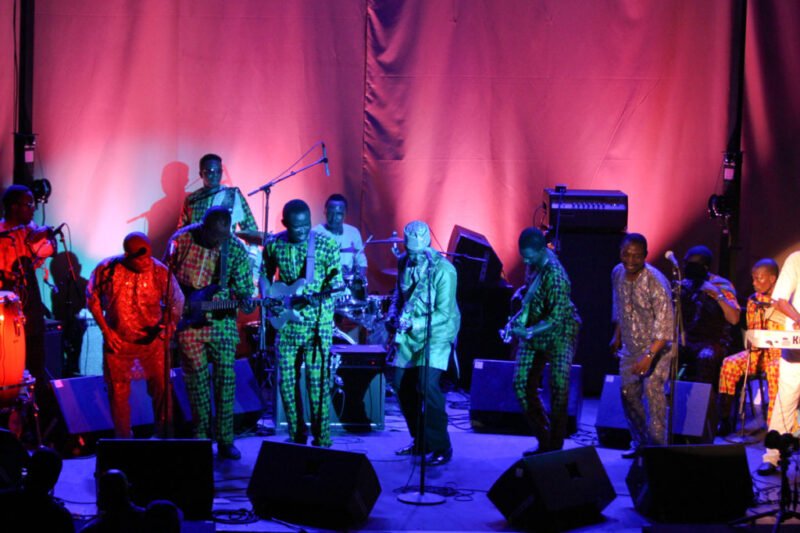
King Sunny Ade does not oscillate between worlds. He occupies a single world that was always built this way, and his life has simply made that architecture visible at a scale most people don’t live long enough, or publicly enough, to show.
This is why his corpus survives contact with modernity rather than being flattened by it. His music is, in this sense, a sustained argument against spiritual docility, not because it says so on record, but because its very form enacts the claim: that the world is full of powers, that they can be called by name without threatening each other, and that a life, like a Juju composition, can hold many voices at once without any of them cancelling another.
That Sunny Ade has been doing this for six decades, in an industry that tries to flatten musicians into product, is itself a kind of miracle. And in his cosmology, miracles are not exceptional events. They are what happens when the structure holds, and everything blends into one another, worlds without end.
Jide Taiwo is the author of K1 De Ultimate: A Legacy Secured, a cultural biography of Fuji music icon King Wasiu Ayinde Marshal, and History Made: The Most Important Songs in Nigeria Since 1999.