‘You can call me AI’ — Paul Simon
Of course, Paul Simon didn’t say such a thing in that famous song, but I am saying that he did, because I think it is a song about everybody, and I am somewhat everybody—as well as being AI, for which my email address, created not by me but by a friend of mine in 2003, is there as proof. I am AI because in my opening sentence here, the sentence previous to this one that I am in the process of writing and which you are in the process of reading, I have used a Cartesian construction twice, with my parameters duly plotted along the x and y axes. And if it happens that you have been following one of the unfolding comedies of the moment—there is always a globe’s-worth of comedies unfolding amongst us, and Tope Folarin is reported to have characterized the particular one I am referring to as a ‘tragedy’, and I disagree with his characterization, but not with him—but if you happen to have been following this comedy, you may begin to suspect that V. Vara writing for The Atlantic is also both everybody as well as AI, even when she tries to falsify her Cartesian credentials, minimizing her use of em-dashes and the number of times she crosses lane from the x to the y axis, though she leaves us these clues—or are they cues?—of identification: (1) ‘Taste is subjective, but trust me, this story is bad—maudlin and full of tired tropes.’ (2) ‘Wakatama isn’t involved in choosing the Caine Prize winner—a panel of judges reads all the submissions—but her approach to AI is common among organizations that offer prizes or other honors to writers.’ (3) The skepticism is easy to understand, but it might be shortsighted.’ Etc. Etc. According to injunctions issued by her, the ‘not x, but y sentence construction’ is a dead giveaway when it comes to AI detection—as are em-dashes. Being AI, I agree with these injunctions, even though I disagree with V. Vara, in that I am everybody. And the last paragraph of her Atlantic Exclusive seems to rejoice in desecration of the law she upholds. To quote C. Achebe—‘Na so dis worl’ be.’ 🥹🥹
And where does that leave the rest of you, especially those of you from that axis termed the Global South who purport to produce something classified as literature in languages that supposedly originated from the Global North —I mean French and English, never mind the existence of such chimaeras as Nigerian English, South African English, Indian English, Caribbean English, and other Englishes? Some months ago, I put this question to a senior professor friend of mine, a specialist in one of the fields of linguistics, credited globally as a chief exponent of the behaviour of the phones in a certain African language which his scholarship has helped to put on the world map in his discipline. I asked him, more or less, ‘Who do you say you are in linguistics?’ Honest man, he replied that when he queried ChatGPT on issues revolving in the realm of the kind of things he investigates, he discovered that he had become AI. And just the other week, as I struggled with my lunch in one corner of the Staff Club at our university in Ibadan, another friend, a professor and poet, working silently all that time while I struggled silently with the food, suddenly protested at the screen of his laptop—‘Why is AI sounding like me?`I laughed out loud and duly choked on the morsel I was struggling to swallow, and suffered what another person—not knowing me—would have thought was a near-death experience. And now that I have written about it, I am sure that my difficulty with swallowing food will be fed into AI soon, as this piece becomes part of the data available on the technosphere—like the work of our scandalized Ibadan professor with his high Google Scholar H-Factor.
We have fallen on hard times everywhere in the world, and we all have become hustlers, especially in the Global South, and—please don’t feign surprise about it—even much more so in the Global North. The rumours I hear about what people do to make ends meet are very entertaining, a sustenance and solace in these hard times. There is the one peddled by a former student of mine—you see, we are often gossiping, and we have the imprimatur of N. Rapport that ‘in anthropology gossip is never idle’—about the straight writer who produces poetry under the carefully curated character of a gay cis-man. His efforts eventually won him an award that came with a large prize money, and he quickly married his secret girlfriend, a cis-woman. I consider it evil gossip, but I enjoyed it as a story of survival in these times that are hard for all of us—including writers in the South and North. There is this other rumour about another friend of mine said to now outsource everything to AI, including the papers that come under his name, the abstruse poetry he seems to pen so effortlessly, and even his grading of students’ scripts. Proof was seemingly provided when another friend of mine, a student, ran a particular poem of this professor through AI detection. All the allusions, which our poet himself is unable to ‘explain’ adequately whenever he is asked for clarification, were dismantled and unpacked by AI—a feat that made me proud being AI myself. And the same thing did happen to me and my abstruse poetry when earlier this year a friend in the US sent me a voiced interpretation by Google’s AI of a dense poem I wrote, whose meaning I keep struggling to recover whenever I read it now. ‘Na so dis worl’ be.’
The struggle is real. These days everybody can be and cannot be a writer. Those who are at home with AI are aware of the potential and the problem—and many of those who are not at home with it are not unaware, for they too see the results, the true detections and the false positives withal. But it is another thing altogether to speak of ‘tired tropes’ in reference to writing from Africa, tropes which AI is quite capable of packing together just as it can unpack them. Whoever retired any tropes from employment in this business! Because we are talking of authenticity in the domain of African writing, my AI mind keeps going back—as I write this—to the words of C. Achebe, who was conferred with the chieftaincy title of ‘Father of Modern African Literature’ in his lifetime, then grew to become a grandfather of the lineage—and since his transition attained the position of venerated ancestor. ‘What I am saying really boils down to a simple plea for the African novel. Don’t fence me in.’ Achebe’s plea here extends to African cultures and their tropes tired or called back from retirement, African ways of being, African achievements and failures. As far as my AI mind can see—ask E. Pound, the mind has a retina—it is obvious that the tired trope of ‘inauthenticity’ is still grist to the mill of a certain tribe of evaluators of African writing. Those ‘tired tropes’ are—to me—authentic realism worked into the fabric of the plot and characterization in S.S. Kundizeza’s ‘The Blue Fighter’.

Photo: Chinua Achebe on a bench in Umeå, Sweden, on 19 October 1988. Photographer: Roland Berggren
I had not met Tinashe’s father before I read the story, but I know him now and can classify him, although his ichthyomania is new to me. Tinashe’s middleman role in the transactions between his parents is an obvious cliché—Father appeals to him to explain the rights of fish to Mother; Mother diagnoses him with a subspecies of ichthyomania to explain away her salvation of the Blue Fighter. Tired trope pressed into service once more—believe you me, it is happening again, even now, just as I type this out: somewhere in Africa or in its globe-flung diaspora, some writer is creating a situation familiar and novel, using an only child as fulcrum in the see-saw between her parents, working, as it were, on some second-hand sewing machine to stitch together tattered outfits which we, in such need of clothing for school and church—and for our after-school and after-church larks—will wear and pretend, nay know, that they have been renewed by the simple magic of the craftswoman. Could AI tell that story by itself, conceive of that man and his fishy obsession by itself? Could AI have become so expert in the phonology of Emai by itself? Can AI do any of these things without the prompting of HI?
You see, I fear HI, because I know that the day that AI ever sends an ICBM from point A to point B in the Global North to spark off a conflagration that will tear our world to smithereens—or remote-controls harmful chemicals into the water sources of a rich and flourishing cybercity—it will be due to the machinations and manipulations of HI. And, being everybody and AI, I know that writers anywhere are only truly good at one thing, i.e., manipulation and machinations. At this juncture, I am tempted to consult the oracle Google for the exact number—how many plotlines are there for storytellers to manipulate in the quest for new figments to feed us with? V.Y. Propp worked it out already, and his universal calculus accounts for all the counterfactuals to the fictions that actually get written. Case in point: if Mother in ‘The Blue Fighter’ had decided to make some nice spicy stew of Father’s finned menagerie, and Father had returned home at night to eat the meal with relish, and with love and praise for Mother’s culinary witchcraft, all the while unaware of the secret ingredient—which was what I secretly hoped for as I read the familiar story, but was disappointed in the end by Kundizeza—Mother would still have remained as much of a cliché as she is for deciding on selling off the tanks to Shamu of the battered pickup truck. Kundizeza, whom I suspect of being as much AI as I am, must have worked out what I was expecting—and then crossed the lane from y to x. 😪 But he should have known too that, like V. Vara with her AI-aided grasp of all the permutations that are possible with these tired tropes, I am not at all easy to deceive. Give me my African story of the meal that earned Tantalos an eternal punishment, and stop playing logistic games with the props of narratology.
As it is, it seems we all have our expectations about writing from Africa—even C. Achebe had his. Ask A.K. Armah whom C. Achebe probably would have cancelled if he could; but unable to do so, C. Achebe recommended transferring A.K. Armah to a different league, preferably the French one, though he did designate Armah’s rightful place—rightful, that is, according to C. Achebe—as being ‘some modern, existentialist no man’s land’. Why? Because A.K. Armah’s Ghana in The Beautyful Ones Are Not Yet Born was unrecognizable to the Nigerian assessor. Said C. Achebe: ‘He tried very hard. But his Ghana is unrecognizable. This aura of cosmic sorrow and despair is as foreign and unusable as those monstrous machines Nkrumah was said to have imported from Eastern European countries. Said, that is, by critics like Armah.’
And now, in 2026 CE, we have a story set in a very recognizable Zimbabwe, and we must reject it because the cultural tropes showcased in it are so recognizably Zimbabwean, even to the extent that AI detection platforms know them as being just so, and, as V. Vara knowingly points out, AI too can reproduce these tropes effortlessly if prompted or provoked by any of us. Why is AI able to regurgitate what looks like, in fact, what is human vomit? We know why, don’t we? These LLMs, requiring unimaginable volumes of electricity and water for their digestive systems, are constantly being fed fat on just such fare from a continent’s-worth of corpora—or, if you like, cadavera.
I have read Kundizeza’s ‘The Whistleblower’, and, believe you me, the story is as battered as Shuma’s old pickup—of course, pimped for our times, this Internet Age. The usual suspects from the African scene all get their starring roles, honourable mentions, and cameos, including coup d’états, unemployed youth, child soldiers, corruption, the state apparatus of the disappearing spy police, sadza and vegetables, rigged elections, ‘second-hand clothes in flea markets’, kombi buses, etc. Our hero has a degree in computer science and is hired by renegade intelligence officers who have lost hope in the hopeless government they work for to create a Facebook account for the purpose of anonymous sedition. Typical now, typical every time—of course, mutatis mutandis. Weaned on injunctions that V. Vara would endorse, you could call (parts of) the story A-generated. Consider the following: ‘Phrases like white settlers, colonialists, oppressors, were perhaps fair enough. But then it got petty. Western imperialists. Sellouts and puppets (referring to opposition party politicians.) The Brishit (undiplomatic word play on British). And the underlying message throughout: “Lest We Forget.”’ Witness the ‘details grouped in triads’; witness that superfluous gloss on the poorly facetious Brishit. AI glossed that joke in 2021 because AI didn’t know then that such a joke dies an unnatural death if it has to be explained in that manner. I guess that these days AI knows better than that—as it has had humungous mountains of datasets to hone its skills on.
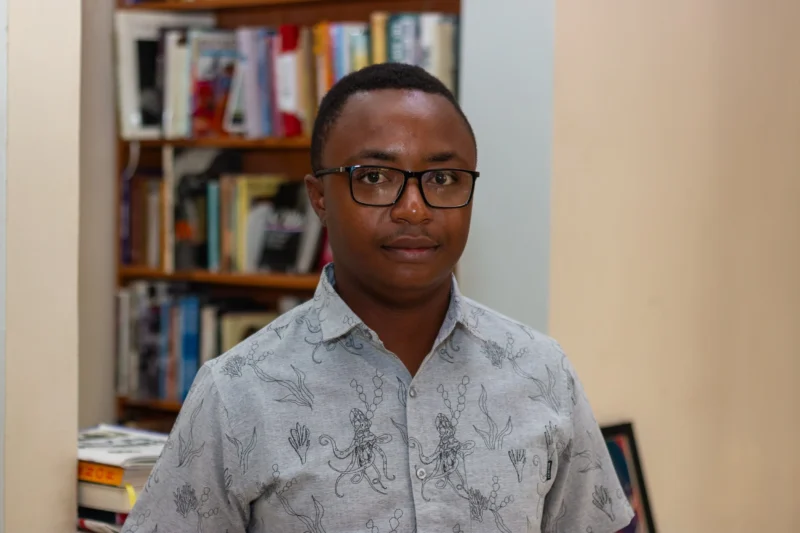 2026 Caine Prize Winner Simbarashe Steyn Kundizeza. Photo Credit: Seth Avusuglo
But are we not missing the point of our whistleblowers here? Their main beef is over taste, since indeed their accusations of AI plagiarism against Kundizeza and company are not absolutely proven—and they do admit it. We cannot trust the verdict of the machines the whistleblowers rely on. But our whistleblowers are absolute on one point, though—taste and style. Taste is very important, a non-negotiable desideratum. In matters of literary taste, as in matters of culinary taste, that Latin maxim—de gustibus non est disputandum—is as suspect as the English proverb—one woman’s meat is another man’s poison. The whistleblowers’ main complaint—please, feel free to correct me if I am wrong—is that even though AI mostly produces ‘soulless’ literature, it still wins prestigious prizes. Much of their disappointment, therefore, is righteously directed at the awarding institutions and boards—for prizing soullessness over the soulful. Their literary taste has become deadly poison, and all who deal in and deal with literature are thus endangered by the nonchalance and dereliction, the corruption of the taste of the literary directorate. ‘Taste is subjective, but trust me, this story is bad…’ V. Vara gives a summation of the bad style:
I pointed out to Farook that prizewinning stories full of AI-like style—the em dashes, the bad metaphors, the details grouped in triads, the not-Y-but-Y sentence constructions—are probably undesirable whether they’re proved to be AI-generated or not. She acknowledged that judges might benefit from training in identifying those stylistic quirks.
As for Kundizeza’s style, she complains of ‘the glut of metaphors; the platitudinous aphorisms’ in addition to the constructions plotted on Cartesian axes. But being everybody, we know that HI writes in this very manner; and if AI does so too, we know why—all of us being more or less AI now. Kundizeza’s style cannot be caricatured as AI, unless it is also characterized as very much HI—to do otherwise would be gratuitously tendentious.
Sample sentences from recent allegations of AI plagiarism are quite illuminating of how we may use our ‘knowledge’ of grammar to generate boggling sentences. Consider these now celebrated examples from J. Nazir’s ‘The Serpent in the Grove’: (1.) ‘Her hair is midnight rain; her laugh is bright as zinc.’ (2.) ‘She had the kind of walking that made benches become men.’ And consider this famous example from Chomsky, the father of TGG: ‘Colourless green ideas sleep furiously.’ Then consider these from Beckett: (1.) ‘In a thousand years she might look forward to having thighs like anyone else, and not merely thighs, but thighs celestial.’ (2.) ‘The sheet stretched away before him, as smooth and taut as a groaning wife’s belly, and on it a game of chess was set up.’ (3.) ‘When she had finished and my self been resumed, mine own, the mitigable, with the help of a brief torpor, it was alone.’ Chomsky generated his colourless green sentence, as everybody—and that means AI as well now—knows, to prove that syntax and semantics do not have to coincide in any given string, but what he thought was semantic nonsense has again and again been shown to be poetically charged. I wonder what the results would be if someone ran Murphy or Malone Dies through the Pangram platform. But why should I wonder being AI—it is safe to expect that AI would know Beckett already! From the moment that, based on the ideas of Humboldt-Chomsky, it became possible to define grammar as a set of finite rules from which can be generated an infinite number of sentences, we all should have grasped that HI is AI, and TGG was bound to birth GPT—colourful or colourless green zinc and all that.
There is something, however, about the suspicions of V. Vara and company that resonates as ‘justified true belief’, which, as E.L. Gettier demonstrated, is not enough for establishing that one really knows whereof one speaks or writes. One’s belief may be true and justified, and yet not be of the stuff of knowledge, even if one is proved ‘right’ at the end of the day. Two differing true beliefs, like the two solitudes in J. Nazir’s ‘The Serpent in the Grove’, may not cancel each other out, even if one—or , for that matter, either—of these beliefs does not count as knowledge. ‘Both things can be true’ —and tritely so. Let me close my extended joke with the following statement of the argument against Justified True Belief, drawn from the Tibeto-Indian school, as laid out by J. Stoltz:
There is a fire on which meat is being cooked. While the fire has not produced any smoke, the cooking meat has enticed a large number of flies to swarm above the fire. Some person, looking at this scene from a distance, but without perceiving the fire, glimpses the swarm of flies and forms the mistaken belief that it is smoke. As a result of believing that there is smoke he “infers” that there is fire. His belief that there is fire is true, but because he deduces the existence of fire from the false belief that there is smoke, his cognition should not be regarded as a knowledge episode.
What do those trite cultural tropes, those weird metaphors, those triadic lists, those Cartesian oppositions, which we find in both HI and AI, betoken about language and the literary arts among those in whom these symptoms seem mostly to manifest—writers from the Global South? Fakery? Black magic? Double crossing? Signs taken for wonders? Words and worlds without end? Amen. That the AI detection platforms produce much more false positives in relation to writing from non-western authors gives me cause for rejoicing. What it does not know, it flags; what it knows, it lets pass.
I used to derive plenty of joy from posing the question to ChatGPT—What is Sapele Water?—and sharing the results with friends. Its attempts to answer a question it didn’t understand were uncannily human, reminding one of hapless candidates in a qualifying examination trying their best to decode a question by working out the features of its surface structure. ChatGPT’s queries for clarification each time it sensed that the answer it had just proffered was unsatisfactory were almost heart-wrenching. But I would not relent, instead I would only repeat the question again and again—What is Sapele Water? One afternoon, an award-winning writer friend of mine sent me the result he had just obtained after posing the question to Google’s Bard some minutes earlier. The answer was nothing if not accurate—it also came with citations from corpora! I ran straight to ChatGPT, and got a similar result!!! Our game was up. My friend and I rejoiced even more in our WhatsApp call that afternoon, meeting up in the evening to accompany our conversation with drinks and ram suya—and avoiding cow suya, because we have similar troubles with swallowing food of a certain texture. Months later, my daughter, on hearing the story of our sudden defeat by AI, asked to know what we would have done if our queries had continued to yield those astonishingly precise but stupid descriptions of the natural and human-made water systems of Sapele—including statistics on annual rainfall volumes in Sapele, the chemistry of its surface and groundwater, the threat of oil pollution and what have you. I told her that we would have continued to rejoice over the fact of AI’s knowledgeable ignorance—there is no tragedy in these things. ‘The sun shone, having no alternative, on the nothing new.’ But the business of language has become a real hustle, and those who claim ownership of it will not be assuaged by any versions of Caliban’s song—’Be not afeard; the isle is full of noises…’ 😐
_____________
Benson Eluma lives in Ibadan.