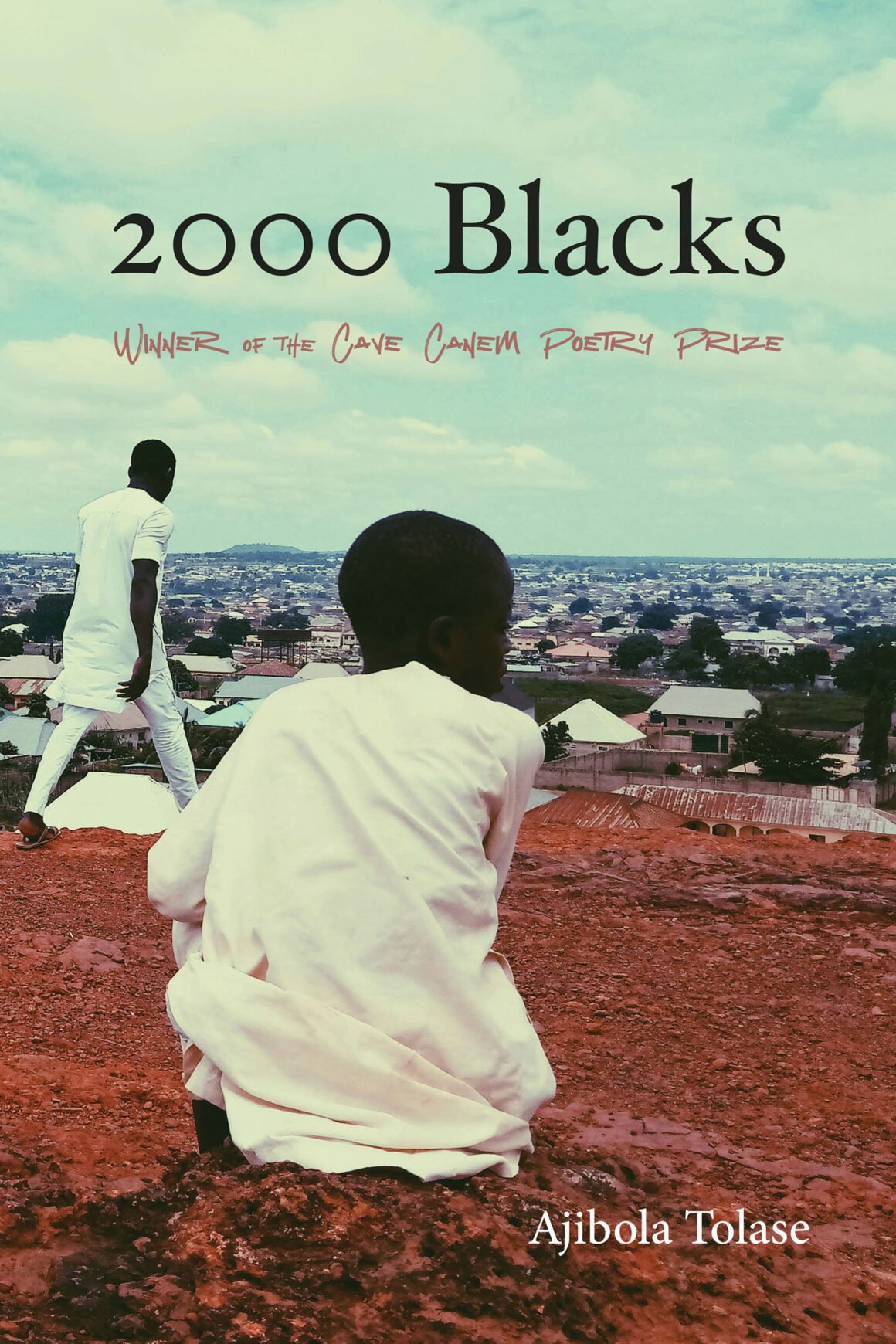
2000 Blacks by the Nigerian poet Ajibola Tolase is a typical debut collection of poems. Typical of books I have read recently, the collection opens with an abecedarian as its introduction, giving enough attention to its supervening concerns as well as to its formal ambition. Titled “Transatlantic,” thus go the first few alphabets:
A is for Atlantic, Africa, of course, Ancestor, America, too. B is for
Bashenga: first man, depending on who I’m lying to. A lineage I have
Claimed when my accent’s origin is questioned by strangers. The
Door I open to mislead people who only want to talk to me about
Elephants and my English language proficiency. Never about their black
Fetish or feigned interest in my culinary skills and my nostalgia for
Goat meat pepper soup. You can find anything here they say except
Home. It is not hate. That has no place here either. It is the
Immigration laws.
As a thematic introduction, “Transatlantic” tells us all we need to know about 2000 Blacks: that it is about the white gaze on the Black body in America; that it is about the stereotypical treatment of immigrants also in America; and that it is just as about the poet’s triumph over the emotional burden of discrimination through self-sufficiency. However, as an introduction to the formal engagements in the book—especially since apprehensible poetic forms are now tertiary considerations, if at all, in contemporary poetry—the abecedarian underwhelms. Hard as a tack and slippery as an eel, the form dictates the movement of the poem with just enough illusion of freedom. Tolase has no recourse except to crawl back to the cool comfort provided by his themes, which is why the legs of his lines are so conveniently long and breathless.
Since the central point of the poem is to criticize and make irrelevant the cutting, discriminating white gaze on the black body by being emotionally self-sufficient and indifferent to the troll of stereotype, the poet turns surrealistic, tracing his referenced ancestor in the second line of the poem, perhaps for serio-comic effect, to the impossibly advanced and dreamily representative cosmos (signalling the historical significance of Africa to human evolution) of the fictional Wakanda and the Wakandan genealogy. The brilliance and effectiveness of this radical allusion is not so that the speaker can hide neatly behind fiction, but so that he can equate the white fiction about Black people with another fiction of his own. However, out of the former fiction—Tolase’s fiction or his metaphorical mythology—are grains of truth because humans indeed do come out of Africa to populate the world. These fictions, raised to the level of historical truth, are, for instance, what the Negritude movement dedicated the bulk of its literary project to addressing: the decolonization of the African mind, propagated through poetry, short stories, novels, and plays describing and celebrating the beauty and uniqueness—historical, cultural, and physical—of Africa as a continent and its diverse people.
In 2000 Blacks, Tolase has seen through the aerosol of the contrived plot of past Western intellectuals, philosophers, historians, and anthropologists to represent, in their works, times and times again, Black people as the inferior race. He communicates this white departure from the Negritude movement (which doesn’t seek to belittle the other, but to celebrate its own essence) by referencing the fatal resistance of slavery by our people in an historic incident that is now known as the Igbo Landing:
…There is an offensive joke about people walking onto slaveships
Pretending to embark on a luxury cruise. It assumes low intelligence
Quotient for people courageous enough to walk back at Igbo Landing without
Rage.
This historical incident is important as it represents many attempts by our enslaved forefathers to fight back against the horrible fate forced upon them. They were not sheep slouching meekly towards their dehumanization; they raged. Thus, the notion of the decolonization of the African mind becomes a myth—however useful—and a fiction—however crucial—to the project of our political self-determination in the post-colonial era. This is because, by that single incident, an argument can be made that our African minds were never colonized in the first place. “Transatlantic” is a gravid poem and deserves its place as the introduction to the book’s preoccupations.
However, as Tolase moves into the book itself, we begin to see that while he has stories in abundance to tell, he often lacks the poetry to tell them. At times, these stories feel too imaginatively far-fetched to establish a basis not only in experiential truth but even in the organic possibility of such versified experiences occurring within the realm of the imagination. A standout example of this phenomenon is “Refugee Sonnet,” a formally ambitious poem written in that faddish form, “crown of sonnets”—a sequence in which the final line of each sonnet is echoed as the first line of the next to establish thematic continuity and progression across the crown. In the poem, Tolase attempts to grapple with too many disparate concerns at once: from the dangers of japa; the terrible stain of colonial parsimony; Western racial perceptions of Black immigrants and the resulting violence against them; the precarious survival of immigrants in foreign lands; immigrants’ self-perception and the burden of constantly justifying their place abroad; to the heavy expectations from families back home—and so, seemingly interminably, on.
This thematic hyper-compression, even at the level of each sonnet in the sequence, ultimately compromises the sequence’s internal structure and emotional logic. Rather than using the crown’s formal constraints to deepen and anchor the narrative, the sonnet frame becomes a mere container for an uncurated inventory of high-stakes traumas. Oftentimes, within a single fourteen-line span (as in the third sonnet), the poem leapfrogs across disparate geographies, historical epochs, and sociopolitical crises: from Sierra Leonean conflict diamonds and medieval Mali to civil-war memory, linguistic misidentification, and Afrobeat iconography. While one might argue that this relentless jumping mirrors the fractured consciousness of displacement, poetic fragmentation still demands internal craft and emotional necessity. Without narrative grounding or room for sensory stillness, these rapid associative leaps downgrade profound historical suffering into mere rhetorical flavor, straining both experiential truth and imaginative possibility.
This tension between formal ambition and emotional logic is nowhere more pronounced than in the sequence’s third sonnet, again, where (alongside being rhythmically spiritless) dramatic, tragic assertions are stacked together without the poetic space needed to work out their narrative truth:
They made their wealth from killings and diamonds. I know I am here
but I don’t belong when people pretend to reference the land when they
say they’ve rescued migrants from dirt. When I object, they reach for
their purses before they shove their fists in my mouth. Then they say let’s
talk Kigali and Monrovia. Once, I met a man in the street who said
he just wanted to be proud of his dark skin. For him I brought
Mansa Musa back to life. But the trolleys of gold didn’t relieve him.
That was a year after I kissed a woman who is now dead because she
spoke eloquent Bambara. She asked if I wanted her tongue and all its stories.
Everywhere we went they called our accents Ghanaian and were wrong every
time. I don’t recall the woman’s words but the charge of her voice, elegant
as the musings of a poet. I can wind the clock back to summer in Bamako
where our skins fitted among bodies marching at a rally. Fela Kuti
thumping from the speakers, repeatedly saying “this is why black men cry.”
The italic is mine to show where the poem fails on arrival for me. Without enough contextual framing and narrative grounding, both of which are the grand failures of “Refugee Sonnet” as a whole, the claim that someone was killed because she spoke a specific Mande language (“eloquent Bambara”) is not only dramatic in the usual sense, but melodramatic in the unusual sense where historical politics is involved. While it is true that this account can be a correct metaphor for certain people’s xenophobic politics and represents the violent streak abutting their sorry, intolerant ideology, it should be noted again that poetry, however flexible to the imagination and tolerant of the poet’s expressive whims, is also a domain of nuance. Otherwise, it cannot be poetry—without the expectation that what we are going to get has both a narrative and emotional logic lurking about the end of the text.
Such shortcomings are prominent because they hinder both Tolase’s larger aim of communicating the great injustices we’ve faced and still facing as Africans in the world and our enjoyment of the poems themselves as their readers. How, for another instance, do you enjoy the poem called “Midwest in the Spring,” about the terrible loneliness of an immigrant in a foreign land, without being taken aback by how the very first sentence of the poem, broken into four lines, lands?
It is the third day of rain
and everyone hates it
but not because the floor
is trembling from cold.
It is easier to imagine people, as opposed to the floor, trembling from cold unless Tolase is trying to transfer that human reaction onto the cold, unfeeling essence of the land to a complicating, even suggestive effect, in which case the paradoxical poem (set in a snowy atmosphere in the season of spring) itself does not make a case for it through context. The rest of the poem is about the speaker’s loneliness and his distance, both physical and emotional, from his home world. In another poem called “Boy,” through which Tolase follows and amplifies the German philosopher Friedrich Nietzsche’s axiom that what doesn’t kill you makes you stronger, we can have so marvelous a beginning as follows in this poem about the simple but teaching events of childhood—where
I fell off my bike and broke
into a dance. If everyone celebrated
what didn’t kill them, we can pretend
to be immortals.
—and yet encounter the same sensibility, in the literal next poem to that brilliant opening above called “Dolls,” writes something so close to pabulum that it assures us of nothing less than the unevenness of both the imaginative and executive facilities at the helm of the accounts in 2000 Blacks. It’s not that Tolase does not have beautiful, even great and necessary stories to tell; that’s exactly what he has in abundance, as “Transatlantic,” “Refugee Sonnet,” and “Boy” have shown. (It is only sad that he writes as though beautiful and important stories are enough material for poetry.) However, in such poems as I’ve mentioned so far and the one I will discuss in a bit to illustrate my point about that unevenness, the beat of the poetry in the poems—that is, the poetic heart, the poetic feeling, or the poetic intuition of the poems—is often silent, and bafflingly so. In “Dolls,” Tolase recounts an experience that will resonate with those of us who’ve been once fortunate enough to be young, free, and playful:
Afraid of getting blood
on the furniture, Yusef
put my finger in his mouth.
We were seven and nine years
clueless of first aid treatments.
He traced the cut with his
tongue.
As seemingly unpoetic as the diction of this beginning is, there is something congenitally poetic about it nonetheless, because it evokes in us a beautiful, nostalgic feeling almost impossible to deny, especially if we have ever been in the same or an equivalent situation when young and transgressive. However, Tolase goes from poetic language in the above passage to a poeticized one in the lines that follow and renders everything lax to the point of imprecision and silly pronouncements, both of which are fatal to the fine sensation established by that gorgeous beginning. To the passage quoted above, this follows:
There was so much
water I thought I must be
drowning.
Where does the water come from, needless to ask about the histrionic drowning? (Perhaps Tolase didn’t get the gist about hyperbole and how its misuse can be just as incredibly devastating to a poem as an illogical, forced, or confusing metaphor.) This is even relatively easy to forgive and overlook, if we are not yet again bombarded by the same exaggerative, as well as exasperating, interruption in the ending of the poem, where what comes immediately before it is Yusef losing “a tooth to an infection,” to which the speaker says: “I was scared the opening in his mouth / was a faucet and that he would always / try to drown me.” How? is the only question that comes to mind.
Even though I am all for recognizing strengths before naming weaknesses in a potentially strong writer, as Samuel Taylor Coleridge remarks in the twenty-second chapter of his Biographia Literaria, Tolase’s structuring of his book in a way that fronts his weaker poems before his stronger ones has made the satisfaction of that critical principle impossible to accomplish. So, though there are debilities—of rhythm, narrative logic, and form—almost everywhere in the first section of the book like rash, Tolase’s stronger works can be seen only in some of those poems, less in the first than in the second section, preoccupied with Nigerian situations under the Nigerian atmosphere and some others on Nigerian urban cities with Lagos as their centre, annealed by the city’s historical significance not only to our nation’s memory of itself but also to the whole of Africa’s.
The poem that redeems the first section from being overrun by a series of weaknesses is “Victoria Island, Lagos.” This is also the poem that closes out the section and, as its title suggests, it is as close to an impeccable ode about the bustling city as any poem can get. Though the poem is no praise for the city, it is a celebration of what the Lagos island inside the city really is—that is, what Lagos itself really is. Lagos is both elegance and violence, both beauty and decay, and both alluring and dangerous, an oppositional duality that the brilliant Nigerian essayist Nzube Nlebedim expresses with bone-clean sentences and clear-eyed facture in his marvelous debut collection of essays At Night Men Take the Lonely Way Back Home. Structured into twelve irregular but self-contained stanzas, the poem and its construction are as precise as a scrimshander, a precision amplified to the point of inevitable execution by each stanza’s preoccupation with an independent subject or situation ranging from the city’s unforgettable memory of slave trade that opens the poem through the its especial propensity for every human evil and what is socially considered vices in the fourth stanza, to the fine description of the corruption at the heart of Nigerian law enforcement in the seventh. While each stanza is as seductive to quotation as a sex worker to good money, the most impressive stanza comes in at the sixth:
A taxi driver once told to me
I have to ignore the city’s history
to love it. It was a wet day, blood trickled
down the windows of the taxi.
The rain sounded like a cry.
I cursed the driver’s smile.
There is a lot going on in the passage, but the lines that have the monotony on poetic compression and are quite impressive are the first two and a half: construction and perception-wise, there is not a single poem in the book better or as good as those lines, and no poem or lines more gravid. Those lines are also easily some of the best any Nigerian poet, past or present, has managed to come up with in our relatively young but vibrant literary history. I mean, forgetting is indeed as important to human evolution as remembering. The only challenge, however, is and has always been our mind sorting or sifting through what to forget and what to remember for our survival. Every city or metropolis thrives on people’s inherent amnesia about the dark history that made their place of residence what it is. If humans, as moral animals with biting and rebellious conscience and irritable towards injustice and evil, do not possess the capacity to ignore (a brilliant diction) the imperfections and turpitude that most of the time build their cities, each of the metropolises we have now would have been empty. Although talking about Lagos, Tolase has the visionary nudge to generalize, extending the statement toward the universal and making the point much heavier like a drench worsted, accomplishes for him what a lot of poets struggle to achieve in a lifetime: an incontrovertibly universal perception put cogently in a memorable diction that is complex in its simplicity.
Meanwhile, since the first section is essentially an undercooked sandwich—the top bread being “Transatlantic” and the bottom bread being “Victoria Island, Lagos” with a raw filling and cold spread in the middle—the second section is so proportionately good that only a smidgen of its spread should be questioned. And if Tolase’s laxness in the previous section has moved us comfortably to doubting his poetic maturity, the epistolary poem called “Brotherman,” written in Nigerian Pidgin and in a sonnet form which rhyme scheme is closely reminiscent of the Shakespearean type (ABAB CDCD EFEF GG) should bring us back to our right senses, especially because poets are better, and have always been, judged by individual poems rather than a collection of them. (The rhyme scheme of its first quatrain, however, is AABB.) The poem begins with the title as its salutation, then goes to the universal truism about the imbalance of life as well as the privilege that is often located in what we have chosen to call accident of birth:
Brotherman,
this life no balance. Person wey chop
say na god. Hungryman no got fit stop
to complain. Pikin wey no suffer think say him wise.
Abeg who teach am? If life do am, him go surprise.
This is the story of our country, says the speaker, further examining the deep corruption embedded in Nigerian institutions of law enforcement and justice with their indiscriminate and senseless killing of the same citizens they swore to protect:
Na the story for we country. Dem kill man
put for road. Police say na robber. Na we sabi
who he be, wetin he carry. He no thief pass woman
heart with him dada hair. Na person daddy
lie down for street so. The pain pass my power.
In the poem that immediately follows, called “Kalakuta Show,” Tolase gives a more precise example of this institutional rot that is our justice system in the temperamental voice of Fela, recounting a historical event concerning the cruel military treatment of his activist mother, Funmilayo Ransome-Kuti, on the 18th of February, 1977, at Kalakuta Republic, Fela’s residence in Mushin, Lagos. While the words of the poems are Tolase’s words but spoken in the voice of Fela, the truth he is imaginatively telling in the poem—which is also a sort of political criticism being renewed—is completely Fela’s from the album of the same name as the title of his poem, particularly echoing the songs “Unknown Soldiers” and “Coffin for Head of State.” Fela is awoken in the middle of the night as he “moved through smoke / like a ghost moves through cloud / to a heaven with no angels.” Indeed, the Nigerian political and social climate of the time couldn’t be captured by a more Miltonic, cogent, or precise metaphor: a heaven with no angels. The devils banishing the metaphorical angels from their heavenward, the leading instrument of the institutional rot in law enforcement agencies and their likes, did just about anything under false pretenses when they get to Kalakuta Republic, a metaphorical representative of the present Nigeria—trampling and beating on people and later burning the residence—as the ending of the poem shows, not only featuring Fela’s injured mother, but also dazzling with its clinching power of a well-placed, inevitable simile—the innocent position and reality of a boy sleeping in a playground arrayed against the terror of an overmastering might:
They herded to the second floor like zombies,
threw my mother out the window.
Her arms were outstretched in the mud
like a child asleep in a playground.
As is apparent here, Tolase can be so ingenious when his efforts seem so effortless. “My homeland,” that “heaven with no angels,” Tolase writes in the shortest poem in 2000 Blacks, “was mortally/ wounded.” A strong apologia for japa, like no other I have read, Tolase bewails the slowly ashing fire of Nigeria’s progression in the metaphorically precise poem called “Embers,” whose third and last stanza reads:
What we swore to
uphold no longer
exists. Everyone
has died, or gone
away. That’s all
I will say.
In our national pledge, “uphold” is one of the three nodal verbs that every Nigerian citizen has hopelessly held to mind since the conception of the pledge in 1976 by the Nigerian scholar and princess Felicia Adebola Adedoyin: “I pledge to Nigeria, my country / To be faithful, loyal and honest / To serve Nigeria with all my strength / To defend her unity / And uphold her honour and glory.” But in time, the honour has been desecrated, too desecrated to make the country even attractive to its own citizens, the lot of whom are now attended with the terrible realization that they have to choose between this “heaven with no angels” and possible alternatives if they should have any hope of surviving and living well. The subtle sentiments in this short poem are neither ridiculously brilliant nor suavely original; what they are is common sense. And there are times when common sense alone is the thing to have in a line of poetry: this is one of those times, and having it has proven, by the force of its pertinent, well-articulated feeling in so many words, to be more than capable of leaving a successful attempt at a ridiculous brilliance or suave originality in the dust of their own making.
Tolase might seem a rare breed of poet until we take into consideration that this collection is his first: he can be so good as to be up there with the best of them and at the same time so bad as to be down there with the most complacent of them that have never tried to improve. Much of 2000 Blacks, like John Keats’s wrongheaded and farcical epitaph, is “writ in water.” However, and again, it is individual poems and not a collection of poetry that we judge and remember any poet by, and so Tolase’s “Victoria Island, Lagos” and “Brotherman” might stand as his saving grace. They are more than enough what other poets achieve in a lifetime of poetic evocations, and they, despite their unmotivating neighbors like “Dolls,” “Midwest in the Spring,” and “Refugee Sonnet,” among others, might just be enough to earn the poet that venerable name in his generation and beyond.
_________
Ancci writes from Ibadan, Nigeria. His writing has been published in or forthcoming from Harvard Review, Cleveland Review of Books, Poetry London, The Republic, The Adroit Journal, Annulet: A Journal of Poetics, Afapinen, and elsewhere. He writes about poetry as an editorial assistant at ONLYPOEMS.