
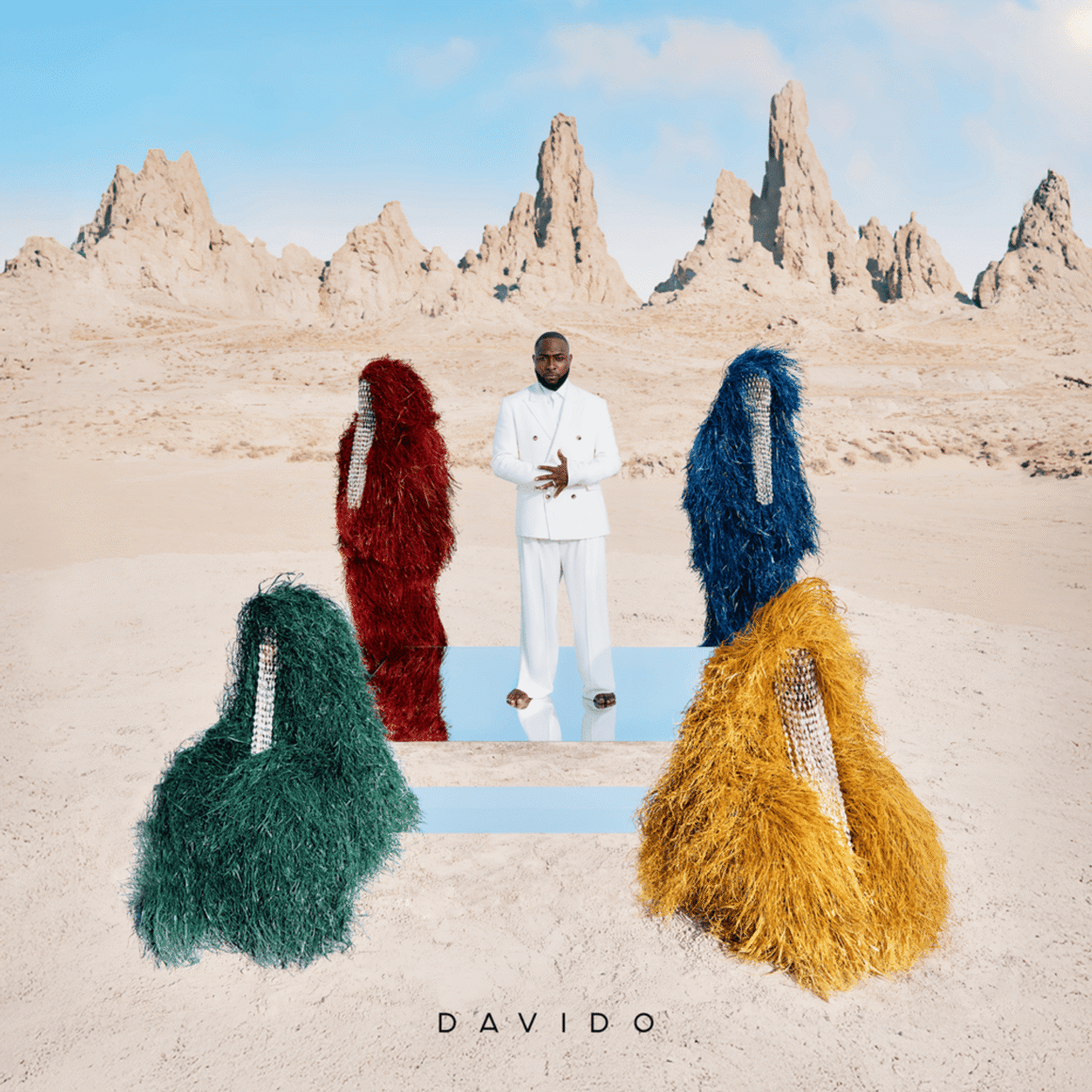
Davido’s fifth album, 5ive, opens with a performance poem of the same title by the Nigerian poet Alhanislam. The poem, which invokes “five” as both symbol and rhythm, works as a thesis for the musical project: balance, struggle, family, freedom, legacy, each central to the album is well framed beforehand in the poem. Its cadence, more concerned with evoking feeling than with testing the limits of language, exemplifies what Wallace Stevens once observed: “There is a sense in sound beyond their meanings.”
Alhanislam’s voice, which constitutes her triad of delivery, tone, and pacing, waxes motivational. When we have registered the rhythm of the poem and get its attendant feeling out of the way, we must arrive at the meaning behind the sound. Hence, an apt subtitle to this playful title of this review is “The Mathematical Subjectivism of Alhanislam’s Five” for a simple, but interesting reason: a thesis for the entire album, the introductory Five establishes the number five as a foundational and balancing element but with a caveat of self-interpretation:
Five is the rhythm of life
A number that speaks of balance
like the pillars holding the sky
and the roots deep in the earth
Objectively, this opening assertion is hard to agree with; three and four are more proper as the numbers representing the “rhythm of life.” Three has a monotony on the beginning, middle, and the end of things; and four has its own in the tetrad classical elements in the earth, water, air, and fire. Odd as zebras, five hardly speaks of anything but imbalances, but this is where the arithmetic subjectivism of the poem appears: the universal concept of “five” is applied and interpreted through the dual angles of Davido’s personal history and artistic journey. In both these senses, the artist not only has a front, back, left, and right, but also a centre which satisfies the poet’s claim of the odd five as a balancing number. Every aspect of Davido’s journey as an “artist,” “father,” and “a man walking two worlds” has led him here.
As one of its winning strategies, the poem alludes to the infamous Biblical story of David and Goliath. The former is a direct comparison with Davido and the snickering world is the tenor of Goliath. The implications of the allusion thus flicker through some of the sixteen songs included in the album along with the poem. The second stanza (or what I take to be the second stanza, reading the refrain of “five” in the poem as the marker of new thematic directions) sees Davido’s inevitable artistic struggles at self-improvement and self-reinvention—as a man and artiste across his five albums, in the restlessly searching and demanding eyes of the world. Through his music, Davido wrestles with the world and the attention it brings him:
Five albums
A colossus of sound and spirit, a phoenix reborn and
as a shepherd once faced a giant with just a sling and a stone,
he too meets his Goliath with a melody all his own
Here, Davido’s transformation and resurgence, in the course of his more than a decade career, is asserted. In “Be There Still,” an early song from 5ive, Davido boasts about his consistency at staying in the zenith of the musical game: “Twelve years, I’m still on top / And my cup runneth over.” The archaic spelling of “runs” harks back to the Biblical narrative established by Alhanislam suggesting the artist is sometimes zonked out by the streak of success that comes as a consequence of grace, personal ambition, and hard work. But as sottish as Davido claims himself to be about the whole streak of grace and dividends paid by his ambition and hardwork, he also understands, as every accomplished person that keeps at it must, that getting drunk on the triumphs leads to destruction. While he can momentarily get drunk on success, he also has recalibrating moments of clarity that allow him to pause: “I get days I sober / Oh, I sober.”
The idea of unshakeable presence that the Biblical David exemplifies and with which Alhanislam compares Davido features and, more allusively so to the equally scriptural narrative of Samson, in the relaxed confidence of “Nuttin’ Dey.” In the second verse of the song, valorizing work (“Me and my guys dey hustle and grind / To make sure say enough money dey to go vibe”) and castigating disloyalty with a curt quickness (“Delilah wan cut my hair, so me I serve her breakfast one time”), Davido once again holds his grounds with a confidence to rival David’s prototypical courage while holding himself beyond the naivety that trumps Samson to his fall: “They can neva stop my shine / No matter how hard dey try.”
In the middle of the poem stands the poet’s celebration of family, which is one of the central themes of the album:
Five siblings
His father’s embrace moulds the future with boundless love and every heartbeat is a promise
Every sibling of his a masterpiece
In the pre-chorus of “Be There Still,” Davido sings about his family and their staunch support throughout his career with an especial reverence. Their singular yet strong presence has allowed him to achieve continuous success with little to no regard given to outside noise:
Holy sign
Fast forward, no rewind
We going high with family for my side, oh (Yea ay yeah)
No be fight (Yeah, yeah)
No be everybody dey my side (Oh, I know, oh)
But I no mind oh, I don’t mind oh
Of course, he doesn’t mind; familial connection, promising “boundless love,” trumps external validation.
Free from the noise with his eyes fixed on moving higher still, Davido, in 5ive, features not less than fourteen artistes in an album of only seventeen songs. Those artistes come from all over the world, ranging from the Nigerians like Victony and Omah Lay, Americans like YG Marley and Becky G., Jamaicans like 450 and Shenseea, South African like Musa Keys, to the French and French-Congolese singers like Tayc and Dadju, respectively. Not exempting the poet, Alhanislam. So, similar to many of his contemporaries like Olamide and Don Jazzy, each accomplished on his own terms, Davido is, in the words of Alhanislam,
Unbound by borders, rising by lifting others
The artist, the father, the man walking two worlds
We spend our lives building bridges only to realize we were meant to soar
Davido founded his own record label Davido Music Worldwide, popularly known as DMW, in 2016. Since then, he has signed more than nineteen artistes on to the label and many of them have gone on to accomplish great feats in the Nigerian music industry: they have eleven or so Headies Awards among them and a score of musical projects that have had a major contribution to the Nigerian popular cultural landscape through the last decade. It is Davido’s accomplishment and legacy in this regard that Alhanislam describes, rather aptly, as “active”: “Legacy is not just what you leave behind but what you breathe into the future.” Legacy is often thought as a posthumous idea but here, Alhanislam rejects that narrow interpretation. Building legacy is an impressive work as constant and relentless as breathing. In the case of Davido, his legacy is active in the music industry because he commits totally to the artistic and human aspects of the work, and he himself is better off for it. He rises higher by raising others up. According to Alhanislam and Davido himself, the math is as simple as 5ive.
Cutting across the thematic nodes of the album, Alhanislam’s Five is more like a considered preface than a blurb; it is everything an introduction is supposed to be: representative of the whole album, contextual, and concise. Even if its lines lean too close to orature to satisfy the stricter conditions of poetry in the traditional sense, Five is rhythmically charged enough to be comfortably situated in the tradition of performance poetry and motivational enough in its legato tone and flouncy delivery to be regarded as one of the finest embodiment of the Gen-Z speak. The performance poem is worthy of the album it preludes and the musical project is more, rather than less, interesting for it.
_________
Ancci writes from Ibadan, Nigeria. His writing has been published in or forthcoming from Harvard Review, Cleveland Review of Book, Poetry London, The Republic, The Adroit Journal, Annulet: A Journal of Poetics, Afapinen, and elsewhere. He writes about poetry as an editorial assistant at ONLYPOEMS.